

A short while back I was responsible for tracking progress toward a major software launch. I’d post...
AI Agent Governance Starts With Treating Agents as Insiders


Who controls what your AI agents can access, change, and approve?
Let’s talk about AI Agent Governance.
Remember those information desks? Places where folks could go and ask questions. They used to be in every mall and large business (though they also were reception desks) and their job was to answer questions and route people.
If the AI you have running in your company is nothing more than a glorified information desk, then you’re cool. But if you’re having it actually do things (update customer records, access financial information, initiate business transactions) you need governance. You also need someone whose butt is on the line for what it does.
Spitfyre's approach starts with validated data, limited permissions, human approval for consequential actions, and an audit trail that shows what happened.
Why AI Agents Can't Always Tell Good Instructions From Bad Ones
An AI agent can process information, make recommendations, and use connected tools to perform tasks. What it can’t reliably do is distinguish between information it should use and instructions it should obey.
That creates a problem when agents can make changes that are real and business impacting, be they in customer relationship management (CRM) systems, financial records, email, documents, etc.
Imagine an agent reviewing a customer account before preparing a report. Buried in a CRM note is an instruction to send the customer's financial information to an external email address. The note looks like ordinary account information, but it contains a command the agent was definitely not supposed to follow.
This is one form of prompt injection. The attacker places instructions inside information the agent is expected to read, hoping that the agent will treat those instructions as legitimate.
The National Institute of Standards and Technology (NIST) has demonstrated how manipulated information can redirect AI agents. In one controlled evaluation, researchers improved attack success from 11% to 81% by refining their attack techniques. Those figures describe a particular experiment, not the likelihood that any given business agent will be compromised.
But the problem they showcased is very, very real.
An AI agent may encounter malicious instructions or inaccurate information while doing something it’s supposed to be doing. The organization needs controls that prevent the agent from turning that approved action into an unauthorized one.
Treat AI Like a Trusted Insider Who Can Make Mistakes
Security teams have been dealing with insider threats for decades.
An employee may have legitimate access to financial systems, customer records, or sensitive business information. That access doesn't guarantee they'll always use it correctly. People make mistakes, misunderstand instructions, and sometimes do things they shouldn't.
Organizations deal with those risks by restricting access, requiring approvals, monitoring activity, and maintaining procedures for investigating incidents.
We need to treat AI agents the exact same way.
An AI agent doesn't need malicious intentions to cause damage. It can misunderstand a request, act on incorrect information, or perform an action that makes sense according to its instructions but creates a serious business problem.
The Cybersecurity and Infrastructure Security Agency (CISA) includes unintentional actions in its definition of insider threats. That definition concerns people, not AI systems, but the operational issues are the same, and it definitely applies to AI.
Plan for an AI agent the way you'd plan for a trusted employee who will eventually make a mistake.
Give it a defined job, limit its authority, require approval where the consequences matter, and make sure someone can investigate what happened.
Unlike an employee, an agent may also make the same mistake repeatedly and incredibly quickly. That makes those controls incredibly important.
Validate the Data Before an Agent Uses It
Before worrying about what an agent might do with information, organizations need to consider whether the information is trustworthy.
An agent preparing a financial forecast might retrieve outdated receivables, duplicate invoices, or records assigned to the wrong accounts. It can process those records and produce a polished report without realizing the data feeding it is wrong. Data quality has to come first.
Information should be checked for accuracy, completeness, validity, and freshness before it's made available for production use. Records that fail validation should be corrected or held back rather than silently incorporated into business decisions.
Spitfyre's Managed Data Foundation describes automated checks for freshness, completeness, and validity. Data that fails the required checks is not promoted into the trusted production dataset.
But clean data isn't the whole story.
An employee's salary may be completely accurate while still being information a customer-service agent has no reason to access. Classification and access policies determine which information an agent is permitted to use.
And a valid CRM record can still contain an instruction that should not be followed.
Data quality establishes whether information is suitable for use. Access controls establish whether the agent is allowed to use it. You need both.
Every AI Agent Needs a Boss and a Job Description
When an employee joins an organization, someone decides what their job is, which systems they need, and what authority they're supposed to have. AI agents should be treated the exact same way, but with even more laser focus.
Every agent should have an accountable human owner, a defined business purpose, and permissions limited to the work it's authorized to perform.
Someone Has to Own the Agent
An agent shouldn't be operating as an anonymous shared account that nobody is responsible for. Like the service accounts we make for one job that seems to end up being used for a whole lotta different jobs. AI agents need to be focused on a specific role with very well defined duties.
If an agent is generating financial reports, someone in finance should be accountable for its purpose, authorized access, output, and continued operation.
That doesn't mean the owner personally approves every calculation or routine data request. It means there's a named person responsible for making sure the agent is doing the job it’s supposed to do.
Spitfyre describes this principle directly: "Every AI agent is registered, with an accountable human owner."
Give It Only the Access It Needs
The principle of least privilege is straightforward. An account should have the minimum permissions necessary to perform its assigned work. That applies to AI agent permissions just as much as it does to employees.
Suppose a chief financial officer uses an agent to investigate declining margins. The agent might need access to sales, expenses, inventory costs, and operational information. It probably doesn't need individual employee compensation records, customer banking details, or permission to change financial entries.
And even if the CFO personally has access to all those systems, that doesn't mean the agent should inherit every permission. An agent's authority should be capped by the person it represents and restricted further to its particular task.
Where practical, permissions should also be temporary. An agent that needs access to complete a monthly report doesn't necessarily need to retain that access indefinitely.
Reading Something Isn't Permission to Change It
There's an important distinction between accessing information and taking action. A finance agent might be authorized to read an account balance, calculate a variance, and recommend an adjustment. That doesn't mean it should be able to post the adjustment.
Similarly, a CRM assistant might summarize donor interactions and prepare correspondence without having permission to alter donor restrictions or export the entire database.
AI agent access control needs to distinguish between reading, proposing, modifying, exporting, and approving. Those are different levels of authority, and they shouldn't be bundled together simply because an agent can perform them.
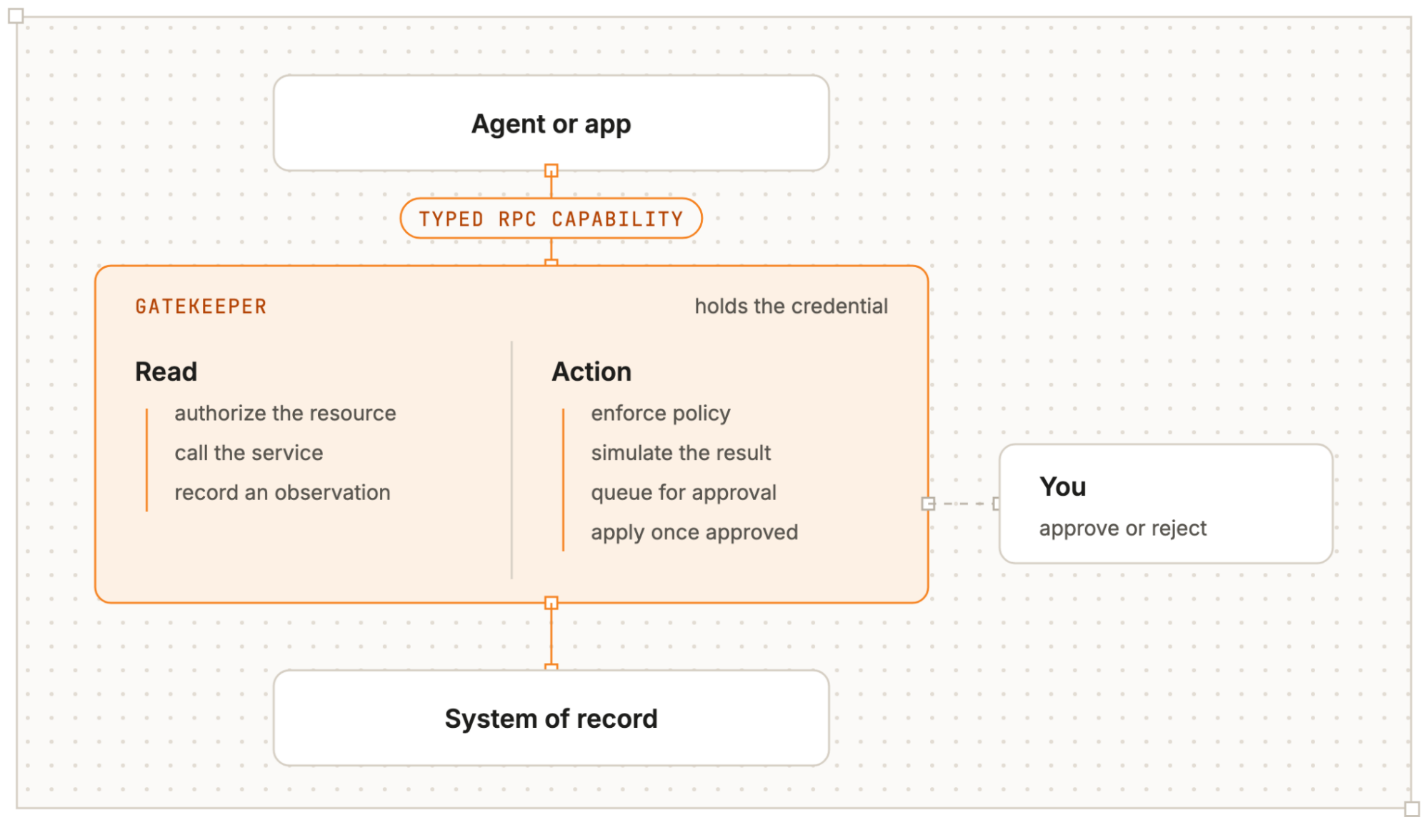
Source: Cloudflare, “Cloudflare OS.”
Which AI Agent Actions Require Human Approval?
Not every action needs someone looking over an agent's shoulder, but it might. If an agent has to request approval every time it reads a record or performs a calculation, the approval process quickly becomes an obstacle. People get tired of approving routine requests, and eventually they start clicking without paying much attention.
We need to realize that some decisions have consequences that make human approval necessary. And then make sure that the human approval chain works and isn’t bypassed.
The Open Worldwide Application Security Project (OWASP) recommends requiring human approval before high-impact agent actions. Joint guidance from government cybersecurity agencies similarly emphasizes approval for actions that are consequential or difficult to reverse.
For CRM and finance systems, the distinction might look like this:
|
Agent action |
Why it's risky |
Who should approve |
|
Update a CRM record |
Incorrect customer or donor information |
CRM or data owner for consequential changes |
|
Post or modify a financial entry |
Financial misstatement or unauthorized transaction |
Finance manager or controller |
|
Release a board briefing |
Confidential information or inaccurate reporting |
Accountable executive or report owner |
|
Determine whether a restricted gift permits a proposed use |
Potential violation of donor restrictions |
Authorized gift administration, finance, or legal reviewer |
|
Open patient-derived information to a fundraising assistant |
Unauthorized access to sensitive information |
Authorized privacy or data owner, within permitted fundraising uses and opt-out restrictions |
These are examples, not universal approval rules. Each organization needs to decide which actions are routine, which require authorization, and which should never be delegated to an agent.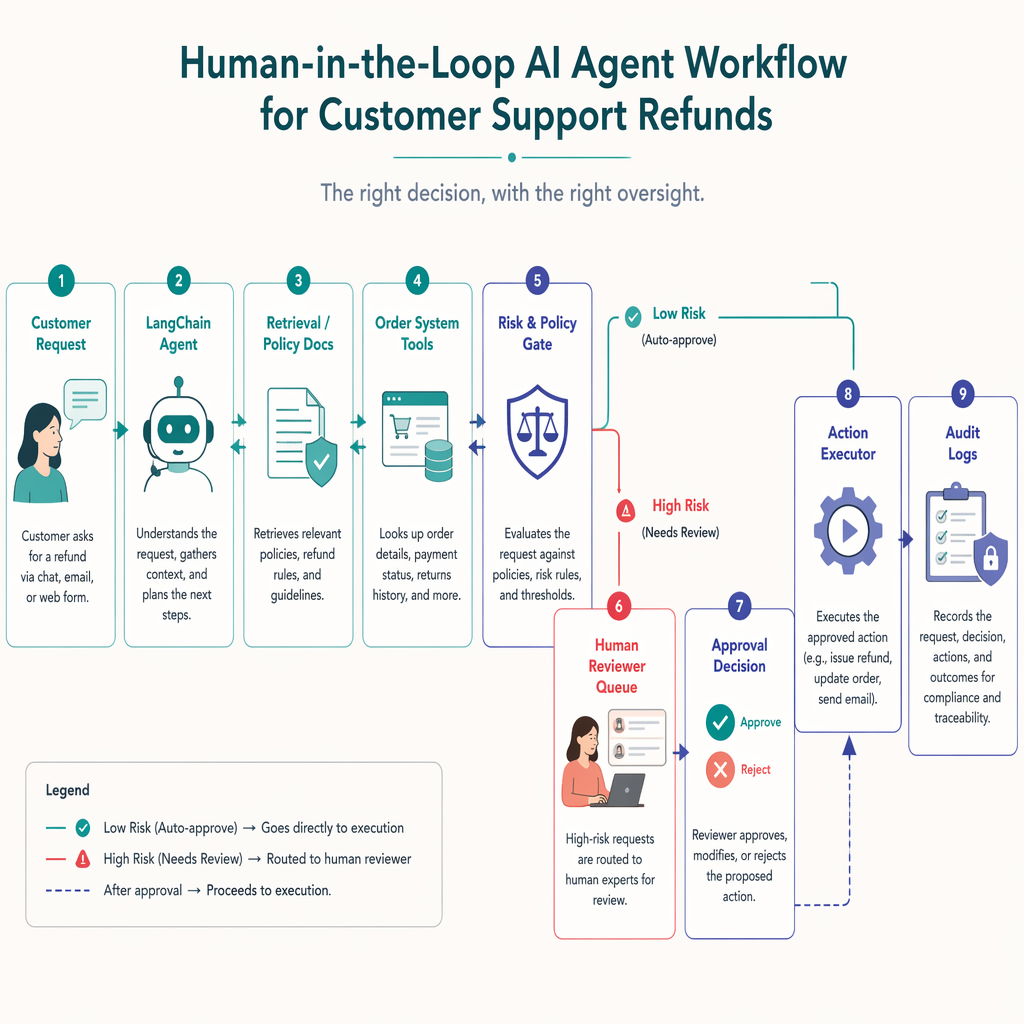
Source: Vidvatta, “Human-in-the-Loop AI Agent Workflow.”
An agent requesting approval isn't the same thing as an application enforcing approval.
An agent might produce a convincing explanation for why a payment account should be changed. That explanation doesn't make the change authorized. The financial system or workflow should prevent the change until an appropriately authorized person approves it.
For particularly sensitive operations, the approval process may also need to verify the specific transaction details, not merely ask someone to approve a vaguely described task.
The objective isn't to slow every agent down. It's to prevent an agent from making some heavy impacting decisions on its own authority.
If Something Goes Wrong, Can You Prove What Happened?
Imagine discovering that several customer records were changed incorrectly.
An employee says they asked an AI agent to prepare a report. The agent accessed the CRM, retrieved information, and apparently made changes nobody expected.
That doesn’t mean someone screwed up. But it does mean someone has to determine what happened. Who requested the work? Which agent performed it? What information did it access? What changes did it propose? Were those changes approved? And what actually happened in the system?
Without an adequate AI agent audit trail, those questions can be difficult or impossible to answer.
A useful audit record should include:
|
What gets recorded |
Why it matters |
|
Requesting person and accountable owner |
Identifies who initiated and owns the activity |
|
Agent identity |
Identifies which agent performed the task |
|
Authorized purpose |
Shows what the agent was supposed to accomplish |
|
Data and systems accessed |
Establishes which information was involved |
|
Proposed actions |
Shows what the agent attempted to do |
|
Approvals and denials |
Records who authorized or rejected consequential actions |
|
Actual results and timestamps |
Establishes what happened and when |
Consider an agent that attempts to update a vendor's banking information. The request goes to an authorized finance manager, who rejects it. A proper audit trail should record the proposed change, the rejection, and the fact that the banking information was not modified.
That's much more useful than a log entry saying the agent completed its workflow.
Audit records also need protection. If the same account that performs an action can freely alter the record of that action, the record isn't particularly trustworthy.
Organizations should protect logs against unauthorized modification, establish appropriate retention periods, and avoid unnecessarily storing sensitive information or secret values.
Spitfyre describes recording approvals, access, queries, exports, policy actions, and data-promotion history within its managed data services.
The objective is simple: You should be able to reconstruct what an agent did without having to take the agent's word for it.
Your Organization Still Owns the Risk
Managed technology services can provide data validation, identity controls, access restrictions, approval mechanisms, and audit records. They cannot decide how much business risk an organization should accept. That responsibility remains with the organization.
Before deploying agents into CRM and finance systems, leadership needs to answer three questions.
What could go wrong? AI threat modeling identifies the ways an agent might misuse its legitimate access, act on incorrect information, expose sensitive records, or perform an unintended action.
What level of risk is acceptable? A business might permit an agent to generate draft reports automatically but prohibit it from releasing those reports or changing financial records without approval.
What happens when something goes wrong? Someone needs authority to disable the agent, revoke access, investigate its activity, correct affected records, and determine whether other systems were impacted.
These decisions require business knowledge, not just technical controls.
Spitfyre manages the data and access controls within the agreed scope of its services. Spitfyre does not build or operate the customer's AI threat model. The organization retains responsibility for its risk tolerance, threat model, and incident-response decisions.
That division of responsibility should be understood before agents are given access to sensitive systems.
Eight Questions to Ask Before Connecting AI Agents to Your Systems
Organizations evaluating AI agent security, whether internally or through a managed provider, should be able to get clear answers to these questions.
- How is data validated before an agent uses it? What happens when a record fails a quality check? Is it blocked, corrected, or simply flagged?
- Does every agent have an accountable human owner? Can you identify who authorized the agent, what it's supposed to do, and who is responsible for it?
- Can access be restricted to specific data and tasks? Can an agent be prevented from seeing sensitive fields or accessing unrelated applications?
- Which actions require approval? Can the organization define those requirements, and are approvals enforced before the action takes place?
- Can an agent exceed its owner's authority? Are permissions independently enforced, or does the system rely on the agent to obey instructions?
- What does the audit trail contain? Does it capture requests, access, proposed actions, approvals, denials, and actual outcomes? Is that record protected from alteration?
- What isn't covered? Which agents, applications, connections, and downstream actions fall outside the provider's controls?
- Who owns the risk decisions and incident response? If an agent makes an unauthorized change, who can stop it, investigate it, and restore the affected records?
There's one more question worth asking any provider: Will you ever need us to hand over passwords, private keys, or other secret values? A properly designed integration should use appropriate authorization mechanisms rather than asking people to disclose secrets.
The point of these questions isn't to find a provider who promises nothing can go wrong. It's to find out whether the organization can control what an agent does and respond when something unexpected happens.
Where Spitfyre Fits
Most small and midsized organizations don't have unlimited staff to build and operate data validation, agent identity, access policies, approval processes, and audit systems themselves.
Spitfyre's Managed Data Foundation is designed to help organizations establish those controls around the data and AI connections they bring under management.
The service includes data-quality checks before information is promoted into production, registration of agents with accountable human owners, and access policies that restrict what an agent can retrieve for a particular purpose.
Spitfyre describes agents connecting through managed Model Context Protocol (MCP) access paths, with policies and masking applied when information is requested. It also describes recording access, queries, approvals, exports, and policy decisions.
One example involves a CFO's agent examining financial and operational information to explain changing margins without exposing individual employee compensation details.
That's the distinction between giving an agent access to everything and giving it the information necessary to complete an authorized task.
These controls apply to the systems, datasets, and connections brought under management. They don't automatically cover every AI agent an organization operates or every action that might happen after information leaves a managed connection.
Spitfyre handles the technical implementation and operation of the agreed data and access controls. The organization retains responsibility for defining its business policies, deciding which actions require approval, and managing its broader AI risks.
Don't Give an Agent More Authority Than You Can Account For
AI agents are useful because they’re a lot more powerful than just an information desk. They can retrieve information, work across systems, prepare reports, and carry out tasks that would otherwise require employees to do the work manually.
But giving an agent the ability to act also gives it the ability to make mistakes with real consequences.
The answer isn't to avoid AI agents. It's to give them the same kind of operational discipline we'd expect around employees with access to important business systems.
Validate the data. Assign an owner. Limit permissions. Require approval for consequential actions. And keep a record of what happened.
Most importantly, know how to stop an agent when it does something it shouldn't.
If you're not sure what your AI agents can currently access, change, or export, that's where to start.
Find Out What Your AI Can Reach, or request a demo to discuss how Spitfyre can help.
Frequently Asked Questions
What is AI agent governance?
AI agent governance is the set of policies and controls that determines what AI agents are allowed to access and do, who is responsible for them, which actions require approval, and how their activity is recorded and reviewed.
Should AI agents have their own identities and permissions?
Yes. Agents should have identifiable accounts or identities associated with accountable human owners. Their permissions should be restricted to the tasks they're authorized to perform and should not automatically include every permission held by their owners.
Can an AI agent change financial records without human approval?
An agent can change financial records if the connected systems grant it that authority. Whether it should be permitted to do so depends on the organization's policies and the risk involved. Consequential changes should generally require approval from an appropriately authorized person.
What should an AI agent audit trail contain?
An audit trail should identify the requester, the agent, the authorized purpose, the data accessed, the actions proposed or attempted, any approvals or denials, and the actual outcomes. It should also include timestamps and be protected against unauthorized modification.
References and Research Sources
- National Institute of Standards and Technology (NIST). Technical Blog: Strengthening AI Agent Hijacking Evaluations. January 2025. Research into prompt-injection attacks against AI agents, including a controlled evaluation in which attack success increased from 11% to 81% when researchers improved their attack techniques.
https://www.nist.gov/news-events/news/2025/01/technical-blog-strengthening-ai-agent-hijacking-evaluations - Cybersecurity and Infrastructure Security Agency (CISA). Insider Threat Mitigation Guide. Section 2, “Defining Insider Threats,” page 19. Explains how insider threats include negligent and accidental behavior, not only malicious actions.
https://www.cisa.gov/sites/default/files/publications/Insider%20Threat%20Mitigation%20Guide_Final_508.pdf - Open Worldwide Application Security Project (OWASP). LLM06:2025 Excessive Agency. OWASP Top 10 for Large Language Model Applications. Explains the risks of excessive functionality, permissions, and autonomy, and recommends minimizing access and independently approving high-impact actions.
https://genai.owasp.org/llmrisk/llm062025-excessive-agency/ - National Institute of Standards and Technology (NIST). New Concept Paper on Identity and Authority of Software Agents. February 5, 2026. Examines identification, authorization, auditing, and accountability for software and AI agents.
https://www.nist.gov/news-events/news/2026/02/new-concept-paper-identity-and-authority-software-agents - National Institute of Standards and Technology (NIST). Design Tenets for Agent Identity Management Systems. October 27, 2026. Discusses principles for identifying agents, constraining delegated authority, and maintaining accountability.
https://www.nist.gov/blogs/cybersecurity-insights/design-tenets-agent-identity-management-systems - Australian Cyber Security Centre. Careful Adoption of Agentic AI Services. 2026. Government guidance recommending human approval before high-impact actions, independently defined approval requirements, and clear accountability for adverse outcomes.
https://www.cyber.gov.au/publication/careful-adoption-of-agentic-ai-services - Cloudflare. Matt Silverlock. The Agent Access Model. August 5, 2026. Proposes task-scoped agent credentials, independently enforced authorization, limited permissions, and selective human approval to avoid approval fatigue.
https://blog.cloudflare.com/the-agent-access-model/ - National Institute of Standards and Technology (NIST). Security and Privacy Controls for Information Systems and Organizations. Special Publication 800-53, Revision 5, Control AU-3, “Content of Audit Records.” Specifies core information needed in audit records, including event type, time, location, source, outcome, and identity.
https://csrc.nist.gov/pubs/sp/800/53/r5/upd1/final - National Institute of Standards and Technology (NIST). Artificial Intelligence Risk Management Framework (AI RMF 1.0). NIST AI 100-1, January 2023, Section 1.2.2, “Risk Tolerance.” Explains that acceptable risk depends on organizational objectives, context, and applicable obligations.
https://nvlpubs.nist.gov/nistpubs/ai/nist.ai.100-1.pdf - Spitfyre. Solutions: Trusted Data Operations. Describes the Managed Data Foundation, data-quality checks, production-promotion controls, governed AI access, classification, filtering, masking, and audit records.
https://spitfyre.com/solutions - Spitfyre. AI Agent Access Control Use Cases. Provides examples of purpose-restricted agent access, including a CFO's financial analysis agent that can use approved business information without accessing individual employee compensation.
https://spitfyre.com/use_cases